Please enter the password to access the project
Bayer x Parsons
Bayer x Parsons
Bayer x Parsons
Bayer x Parsons
Made for
Made for
Made for
Bayer Global
Bayer Global
Bayer Global
Bayer Global
Year
Year
Year
2025
2025
2025
2025
A Parsons x Bayer collaboration aimed at scaling a self-sustaining Innovation Sprint model across a global enterprise.
A Parsons x Bayer collaboration aimed at scaling a self-sustaining Innovation Sprint model across a global enterprise.
A Parsons x Bayer collaboration aimed at scaling a self-sustaining Innovation Sprint model across a global enterprise.
Overview
Overview
Overview
Overview
This project is an ongoing academic collaboration between students from the MS Strategic Design and Management program at Parsons School of Design and Bayer, a global healthcare and agriculture enterprise. Bayer's IT organisation is actively transforming from a service provider into an Innovation Engine, using a 5-day cross-functional Innovation Sprint model to drive rapid problem solving across global teams. The core challenge is making this model scalable and self-sustaining, with minimal dependency on a central facilitation team. As part of Team Northbound, I contribute across research, UX strategy, and design.
This project is an ongoing academic collaboration between students from the MS Strategic Design and Management program at Parsons School of Design and Bayer, a global healthcare and agriculture enterprise. Bayer's IT organisation is actively transforming from a service provider into an Innovation Engine, using a 5-day cross-functional Innovation Sprint model to drive rapid problem solving across global teams. The core challenge is making this model scalable and self-sustaining, with minimal dependency on a central facilitation team. As part of Team Northbound, I contribute across research, UX strategy, and design.
This project is an ongoing academic collaboration between students from the MS Strategic Design and Management program at Parsons School of Design and Bayer, a global healthcare and agriculture enterprise. Bayer's IT organisation is actively transforming from a service provider into an Innovation Engine, using a 5-day cross-functional Innovation Sprint model to drive rapid problem solving across global teams. The core challenge is making this model scalable and self-sustaining, with minimal dependency on a central facilitation team. As part of Team Northbound, I contribute across research, UX strategy, and design.
This project is an ongoing academic collaboration between students from the MS Strategic Design and Management program at Parsons School of Design and Bayer, a global healthcare and agriculture enterprise. Bayer's IT organisation is actively transforming from a service provider into an Innovation Engine, using a 5-day cross-functional Innovation Sprint model to drive rapid problem solving across global teams. The core challenge is making this model scalable and self-sustaining, with minimal dependency on a central facilitation team. As part of Team Northbound, I contribute across research, UX strategy, and design.
Made for
Made for
Made for
Made for
Bayer Global
Bayer Global
Bayer Global
Bayer Global
Industry
Industry
Industry
Industry
Enterprise Innovation Strategy
Enterprise Innovation Strategy
Enterprise Innovation Strategy
Enterprise Innovation Strategy
Context
Context
Context
Context
Strategic Design
Strategic Design
Strategic Design
Strategic Design
System Design
System Design
System Design
System Design
UX research
UX research
UX research
UX research
Content
Content
Content
Content
Duration
Duration
Duration
Duration
Ongoing (Academic Collaboration)
Ongoing (Academic Collaboration)
Ongoing (Academic Collaboration)
Ongoing (Academic Collaboration)
The Challenge
The Challenge
The Challenge
The Challenge
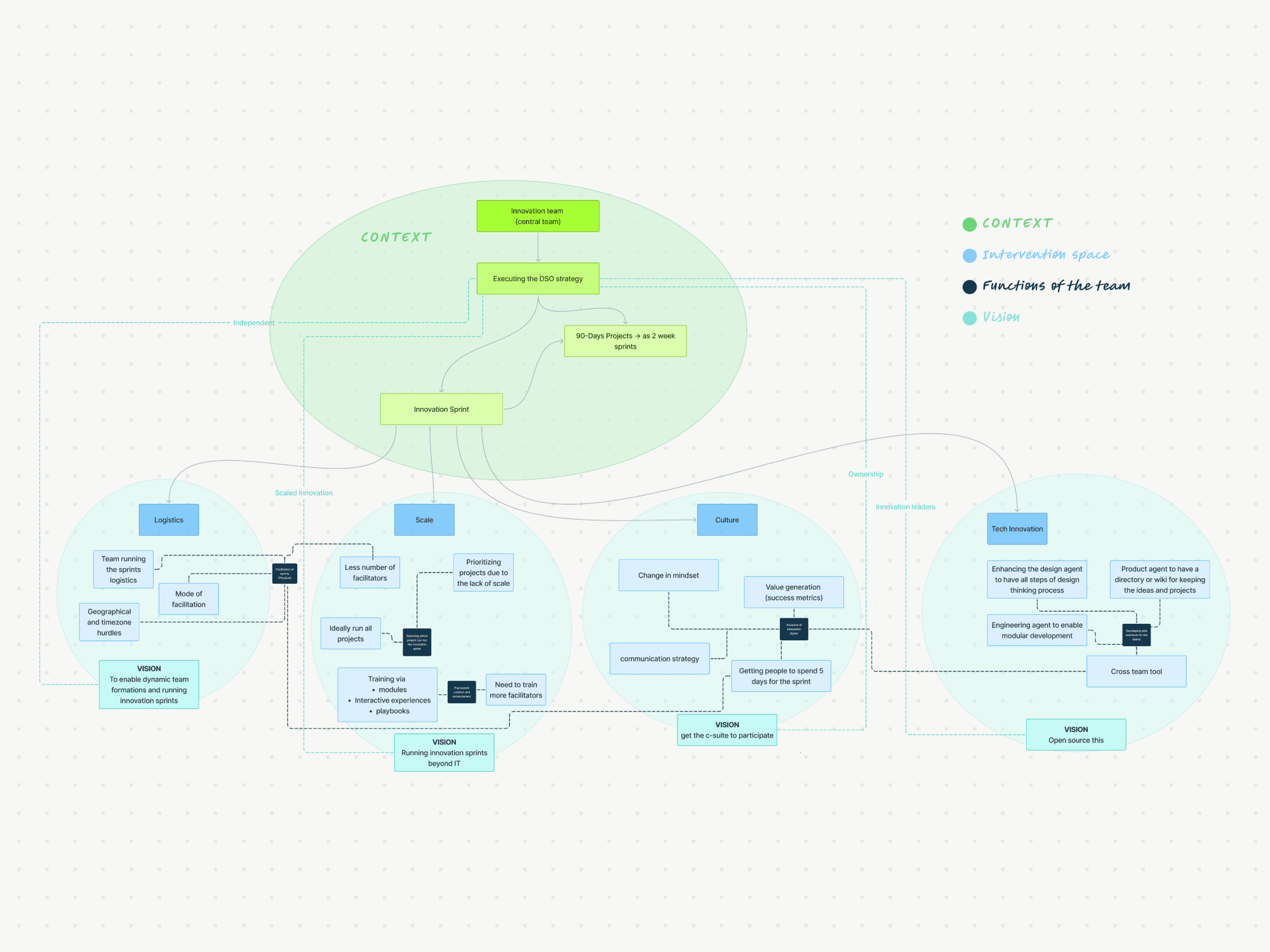
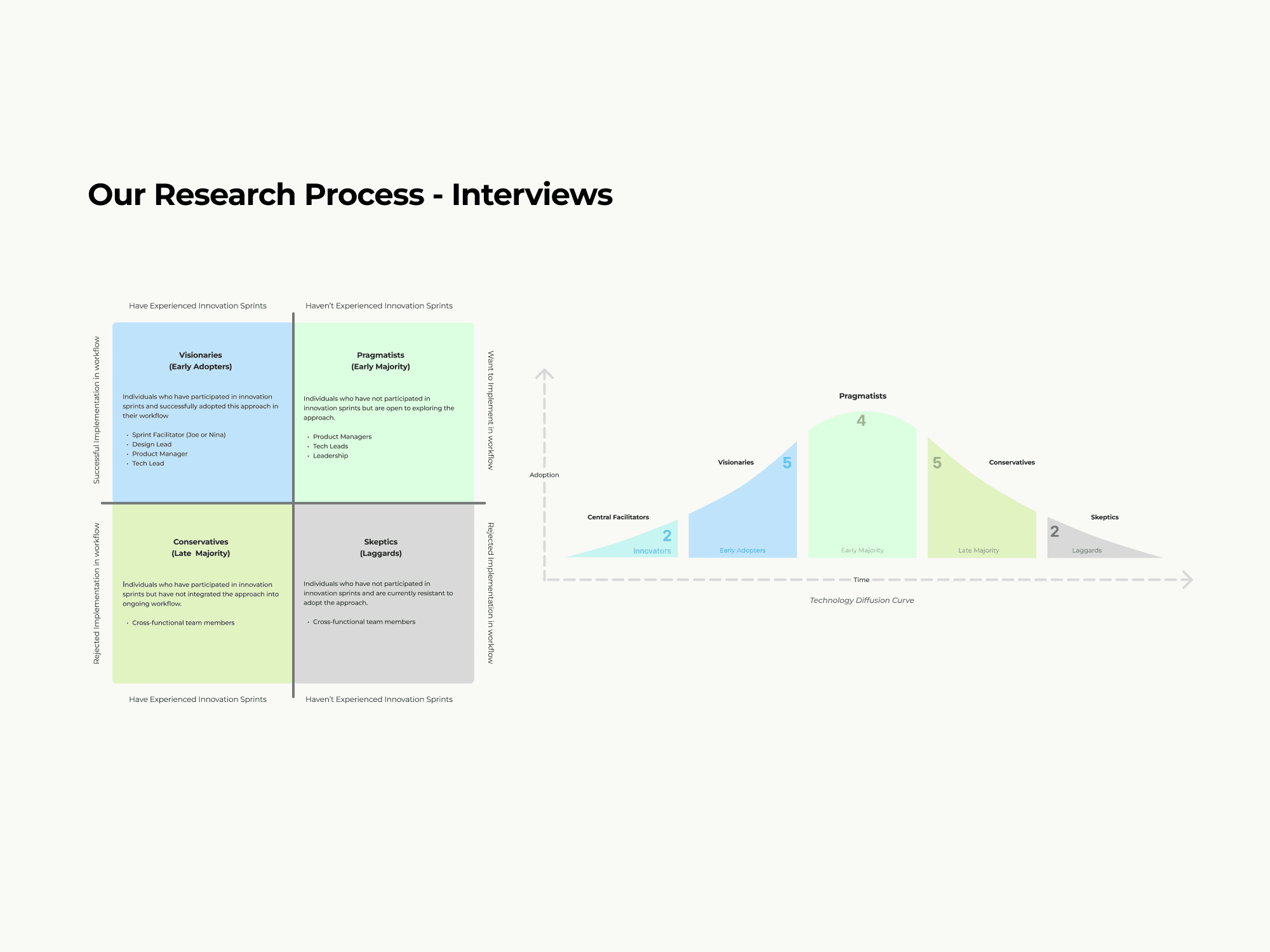
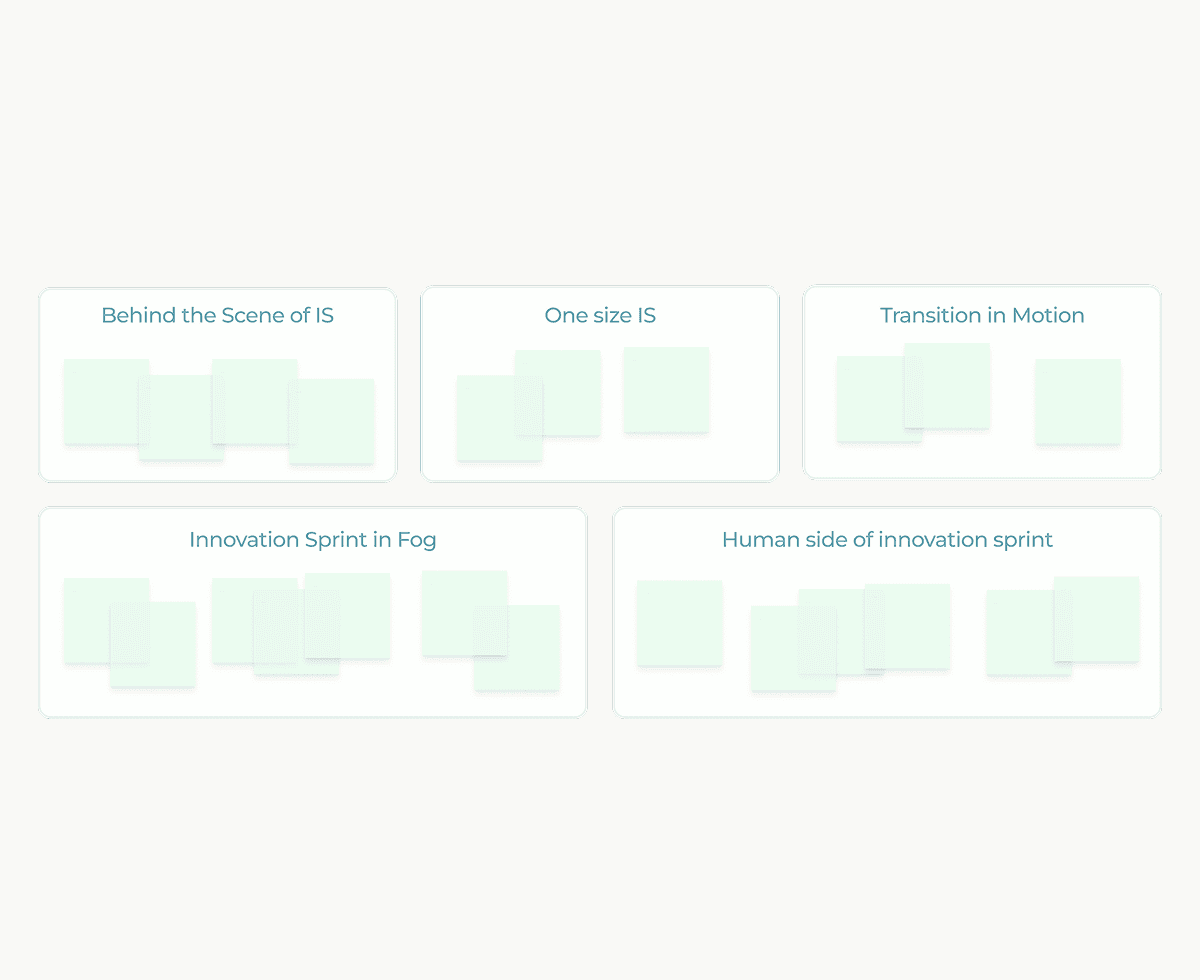
Bayer's Innovation Sprint model works well when the right conditions exist, but scaling it across a large, hierarchically rooted global organisation is far more complex than replicating a process. Through primary and secondary research with 18 participants spanning visionaries, pragmatists, conservatives, and skeptics across the adoption curve, the team identified five interconnected themes blocking effective scaling: innovation sprints being treated as a one-size-fits-all method, overlooked human factors like psychological safety and tech literacy gaps, lack of shared understanding of the sprint's purpose and value, hidden operational barriers in facilitation and stakeholder involvement, and deep organisational inertia stemming from a culture in transition.
Bayer's Innovation Sprint model works well when the right conditions exist, but scaling it across a large, hierarchically rooted global organisation is far more complex than replicating a process. Through primary and secondary research with 18 participants spanning visionaries, pragmatists, conservatives, and skeptics across the adoption curve, the team identified five interconnected themes blocking effective scaling: innovation sprints being treated as a one-size-fits-all method, overlooked human factors like psychological safety and tech literacy gaps, lack of shared understanding of the sprint's purpose and value, hidden operational barriers in facilitation and stakeholder involvement, and deep organisational inertia stemming from a culture in transition.
Bayer's Innovation Sprint model works well when the right conditions exist, but scaling it across a large, hierarchically rooted global organisation is far more complex than replicating a process. Through primary and secondary research with 18 participants spanning visionaries, pragmatists, conservatives, and skeptics across the adoption curve, the team identified five interconnected themes blocking effective scaling: innovation sprints being treated as a one-size-fits-all method, overlooked human factors like psychological safety and tech literacy gaps, lack of shared understanding of the sprint's purpose and value, hidden operational barriers in facilitation and stakeholder involvement, and deep organisational inertia stemming from a culture in transition.
Bayer's Innovation Sprint model works well when the right conditions exist, but scaling it across a large, hierarchically rooted global organisation is far more complex than replicating a process. Through primary and secondary research with 18 participants spanning visionaries, pragmatists, conservatives, and skeptics across the adoption curve, the team identified five interconnected themes blocking effective scaling: innovation sprints being treated as a one-size-fits-all method, overlooked human factors like psychological safety and tech literacy gaps, lack of shared understanding of the sprint's purpose and value, hidden operational barriers in facilitation and stakeholder involvement, and deep organisational inertia stemming from a culture in transition.
The Solution
The Solution
The Solution
The Solution
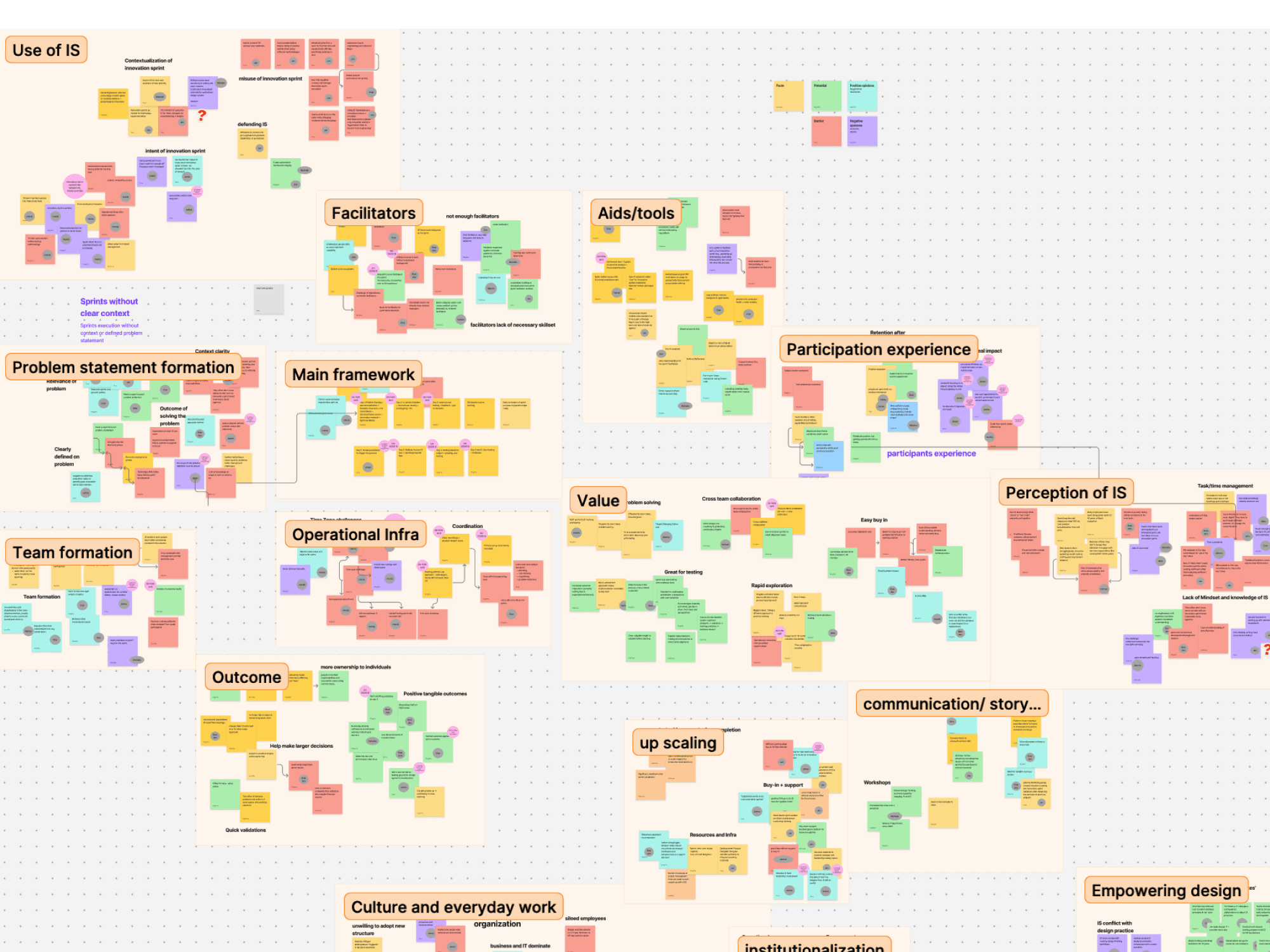
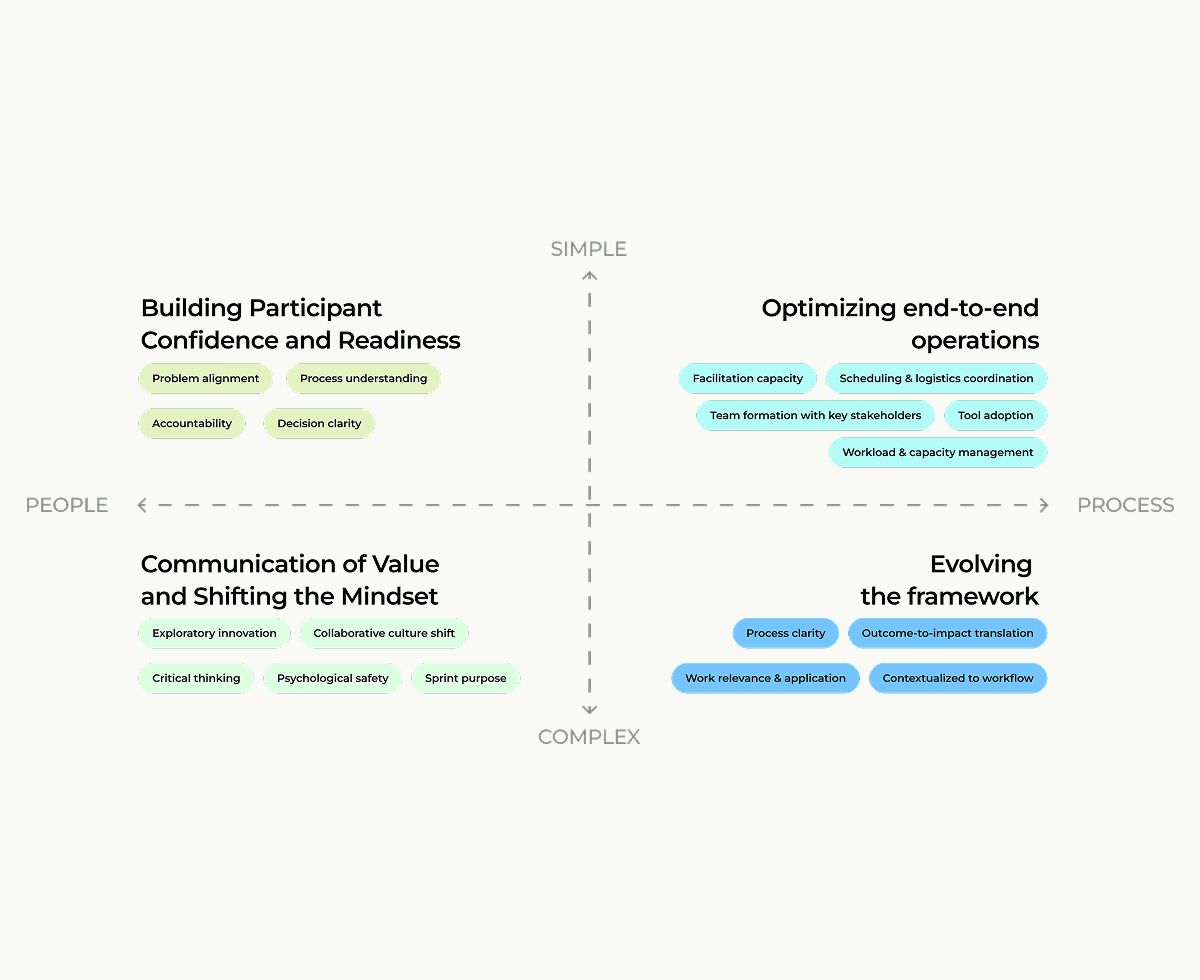
The research phase involved stakeholder interviews, affinity mapping, insight synthesis, and opportunity framing, culminating in a two-dimensional HMW framework mapped across people vs process and simple vs complex axes. This surfaced four key opportunity areas: Building Participant Confidence and Readiness, Optimizing End-to-End Operations, Communication of Value and Shifting the Mindset, and Evolving the Framework. The team presented these findings directly to Bayer stakeholders in a collaborative workshop, inviting their input to prioritise which opportunities to take forward into the design phase. The project is now transitioning into ideation and solution design.
The research phase involved stakeholder interviews, affinity mapping, insight synthesis, and opportunity framing, culminating in a two-dimensional HMW framework mapped across people vs process and simple vs complex axes. This surfaced four key opportunity areas: Building Participant Confidence and Readiness, Optimizing End-to-End Operations, Communication of Value and Shifting the Mindset, and Evolving the Framework. The team presented these findings directly to Bayer stakeholders in a collaborative workshop, inviting their input to prioritise which opportunities to take forward into the design phase. The project is now transitioning into ideation and solution design.
The research phase involved stakeholder interviews, affinity mapping, insight synthesis, and opportunity framing, culminating in a two-dimensional HMW framework mapped across people vs process and simple vs complex axes. This surfaced four key opportunity areas: Building Participant Confidence and Readiness, Optimizing End-to-End Operations, Communication of Value and Shifting the Mindset, and Evolving the Framework. The team presented these findings directly to Bayer stakeholders in a collaborative workshop, inviting their input to prioritise which opportunities to take forward into the design phase. The project is now transitioning into ideation and solution design.
The research phase involved stakeholder interviews, affinity mapping, insight synthesis, and opportunity framing, culminating in a two-dimensional HMW framework mapped across people vs process and simple vs complex axes. This surfaced four key opportunity areas: Building Participant Confidence and Readiness, Optimizing End-to-End Operations, Communication of Value and Shifting the Mindset, and Evolving the Framework. The team presented these findings directly to Bayer stakeholders in a collaborative workshop, inviting their input to prioritise which opportunities to take forward into the design phase. The project is now transitioning into ideation and solution design.
The Result
The Result
The Result
The Result
Research complete with validated opportunity areas co-created with the Bayer team. Currently moving into the design phase to develop concepts that address the most critical barriers to scaling innovation across the organisation. Final outcomes to be presented to Bayer upon project completion.
Research complete with validated opportunity areas co-created with the Bayer team. Currently moving into the design phase to develop concepts that address the most critical barriers to scaling innovation across the organisation. Final outcomes to be presented to Bayer upon project completion.
Research complete with validated opportunity areas co-created with the Bayer team. Currently moving into the design phase to develop concepts that address the most critical barriers to scaling innovation across the organisation. Final outcomes to be presented to Bayer upon project completion.
Research complete with validated opportunity areas co-created with the Bayer team. Currently moving into the design phase to develop concepts that address the most critical barriers to scaling innovation across the organisation. Final outcomes to be presented to Bayer upon project completion.
PORTFOLIO
PORTFOLIO
CHECK OUT SOME MORE
CHECK OUT SOME MORE
CHECK OUT SOME MORE
CHECK OUT SOME MORE

AI Tech Debt Platform
AI Tech Debt Platform
AI Tech Debt Platform

System Design
MVP to Scale
Product Design
Agentic AI
Modular Development
Buttercookies
Buttercookies
Buttercookies
Design System
Design Tokens
Atomic Design
Dev Handoff
Build with me
Build with me
Build with me
Open to internships, full-time roles, and meaningful collaborations
Open to internships, full-time roles, and meaningful collaborations
Open to internships, full-time roles, and meaningful collaborations
.